

Jamini Roy (1887-1972) was an iconic figure of 20th-century Indian Modernism, celebrated for a distinctive visual narrative that rejected Western academic conventions in favor of Bengali folk traditions. After graduating from the Government School of Art in Calcutta, where he trained in a European classical style, Roy initially found success as a portrait painter. However, his style soon evolved due to the rising wave of Indian Nationalism of his time, opening a desire to find a truly indigenous aesthetic. He began to "unlearn" his formal training, looking inward toward the rural visual vocabulary of his roots. Drawing primary inspiration from the Patua (scroll) and Kalighat temple paintings of Bengal, Roy revolutionized his practice by embracing a flat perspective and minimalist, geometric approach to the human form. His primary materials included natural pigments derived from local minerals, seeds, and soot, applying them with bold, sweeping outlines. His subject matter ranged from animals, villagers, singers, to religious icons, transforming normally perceived subjects into iconic imagery, characterized by his signature almond-eyed figures and vibrant, earthy palettes. Roy’s work became a powerful symbol of Indian identity, earning him deep resonance both at home and abroad. In 1954, he was honored with the Padma Bhushan, and in 1976, the Government of India declared his body of work a "National Treasure." His art is held in prestigious permanent collections worldwide, including the National Gallery of Modern Art (NGMA), New Delhi; The Victoria and Albert Museum, London; and The Metropolitan Museum of Art, New York.
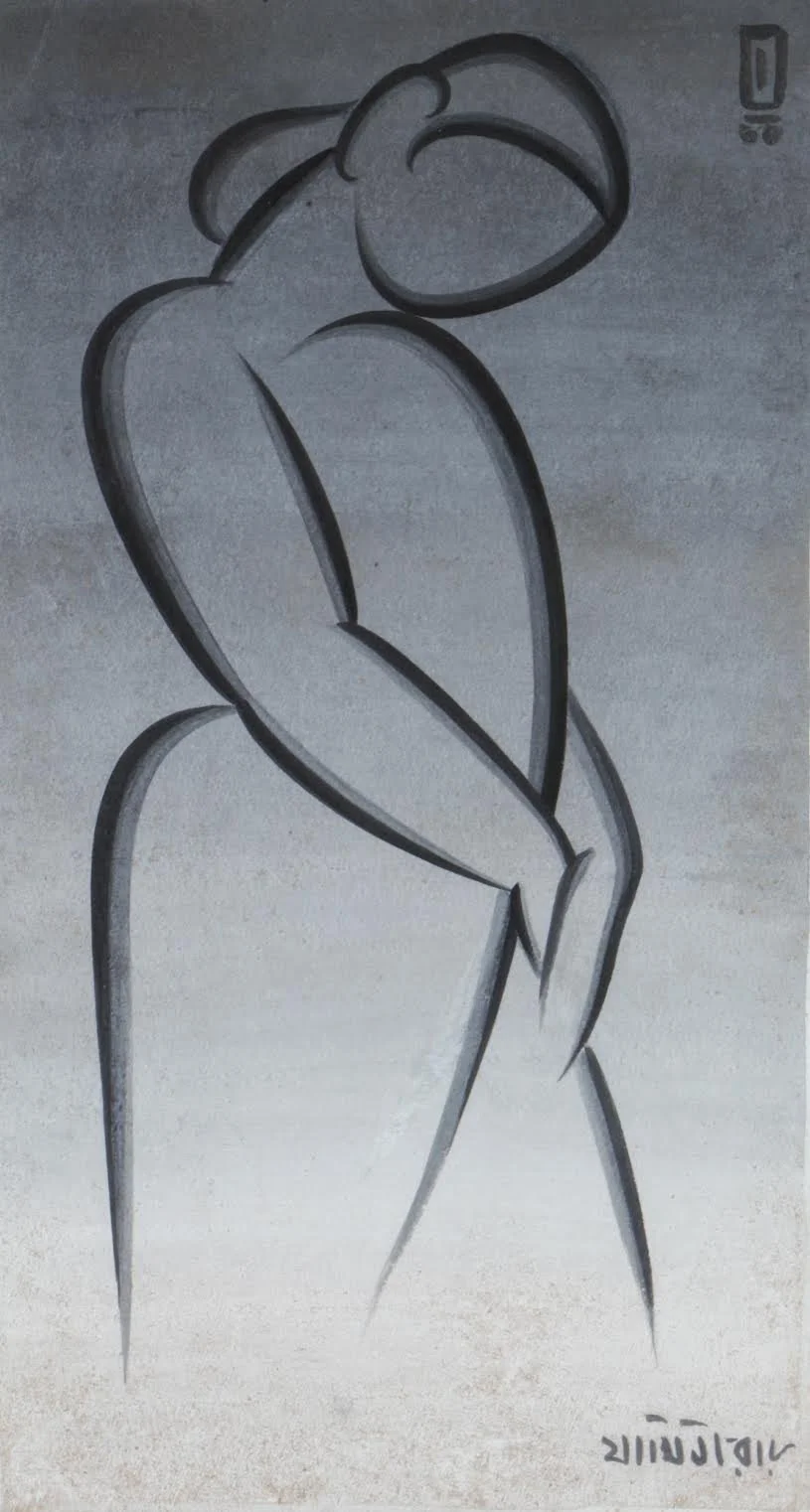
Untitled (Woman Standing)
circa 1920
27 x 14 1⁄4 in. (68.6 x 36.2 cm.)
Tempera painting on cardboard
Framed