

A pioneering Indian modernist, Avinash Chandra (1931–1991) was celebrated for his distinctive visual expression synthesizing Indian and Western influences. Born in Simla, Chandra studied at the Delhi Polytechnic Art Dept. developing an early style marked by stylized urban landscapes and architectural forms. His artistic direction pivoted when he moved to London in 1956 to study at the Central School of Art. Immersed in post war western European art, Chandra moved away from literal landscapes toward fluid abstraction, incorporating intricate, calligraphic line work, geometric shapes, and vibrant colors. Simultaneously, his practice remained rooted in his heritage, embracing Neo-Tantric philosophy and concepts of primal energy; a fusion famously embodied in the sculptural friezes of Khajuraho. This synthesis of environments and influences evolved into his definitive, avant-garde style. Chandra achieved significant international acclaim during the 1960’s, becoming one of the first Indian artists to gain widespread recognition across Europe in the United States. In 1962, he became the first Indian artist to have a work acquired by the Tate Gallery in London, and his paintings were subsequently featured in major international exhibitions, including Documenta III in Kassel, Germany. Throughout his career, Chandra maintained a masterly command over mixed media, seamlessly, blending ink, watercolor, oil, and glass. Today, his works are held in premier, public and private collections globally, including solo gallery shows in New York and London. Prestigious permanent collections worldwide include the The Musee d’art Modern, Paris, Tate Britain, the Victoria & Albert Museum, London, and the national Museum of Modern Art, New Delhi.
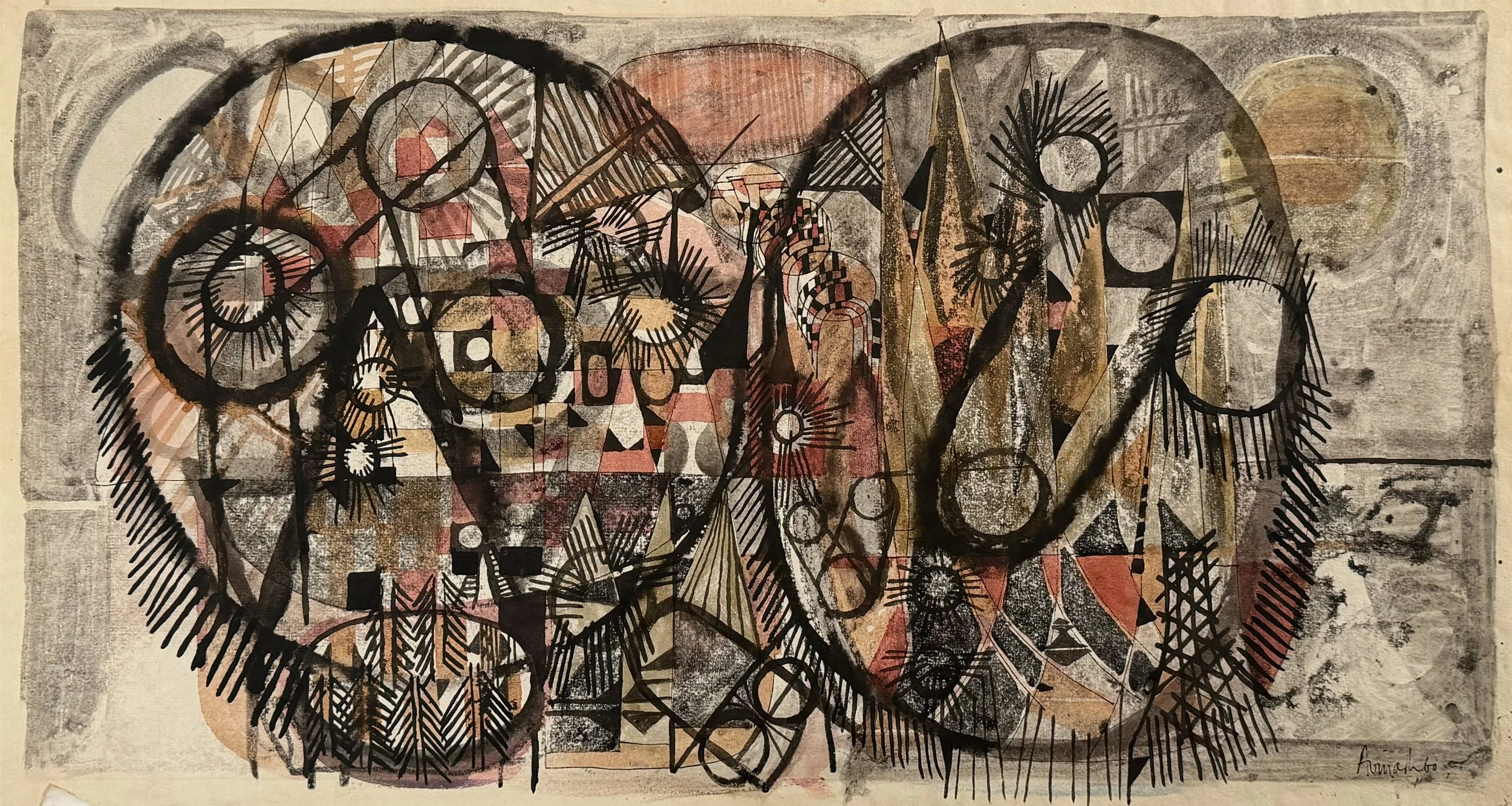
“Untitled Composition”
Circa 1960s
Mixed Media on paper
24.6 x 13.6 in. (62.5 x 34.6 cm.)